I Feel Guilty I Can't Care for My Parent Myself. What Should I Do?
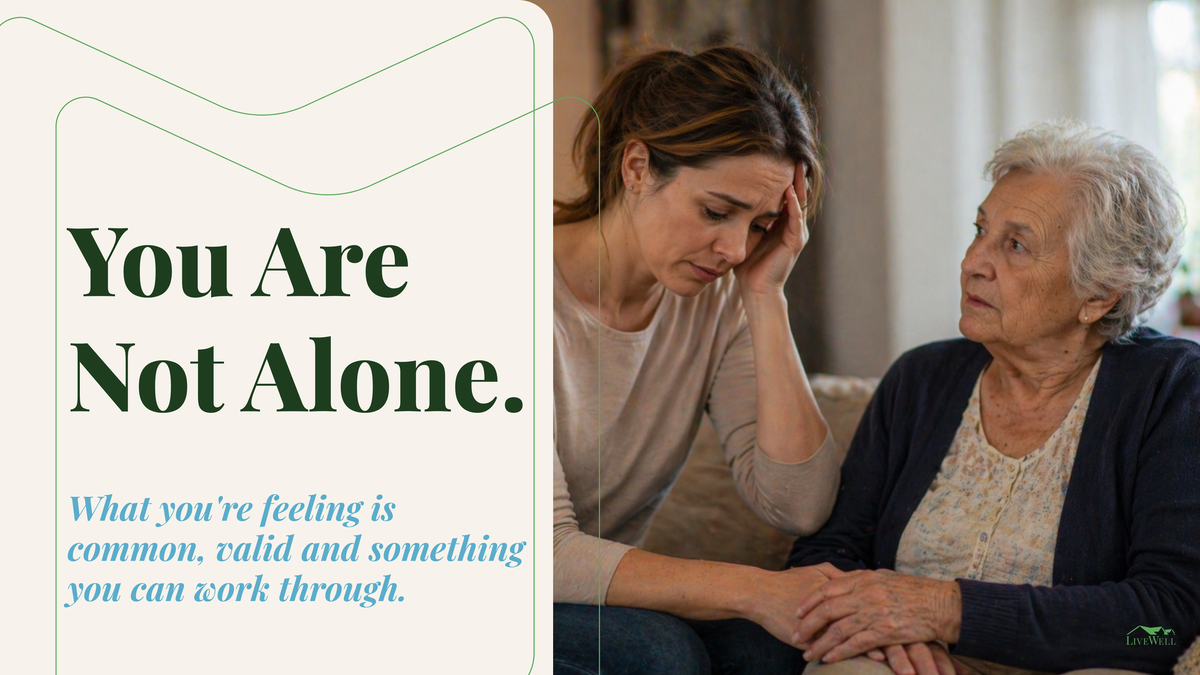
If you've typed some version of "I feel like a bad son or daughter for not doing more for my mom" into a search bar at 1am, you are not alone. The guilt that comes with feeling like you cannot personally do everything your aging parent needs is one of the most quietly painful experiences a family can face.
It shows up in the smallest moments: when your father asks why you can't just stay longer, when you lie awake running through everything that needs doing, or when a well-meaning relative makes a passing comment that lands like a verdict. You love your parent deeply, and that love is exactly what makes this so hard.
This article is for you. Not to dismiss your guilt, but to help you understand where it comes from, why it often doesn't reflect reality, and what you can do to move forward in a way that truly serves your parent and yourself.
Americans provide unpaid care to an adult family member
AARP / NAC, 2020
of family caregivers report significant emotional distress or burnout
National Alliance for Caregiving, 2022
of older adults say they want to stay in their own home as long as possible
AARP Home Survey, 2021
“Caregiver guilt is not a sign that you failed. It is a sign that you care deeply, and that you are holding an impossible standard against yourself.”
Why caregiver guilt is so widespread
Caregiving guilt is rooted in a cultural narrative, particularly strong in Western and many immigrant family traditions, that places direct, hands-on care as the ultimate expression of love for a parent. If you are not the one cooking every meal, driving every appointment, and managing every daily need yourself, the implication is that you have somehow come up short.
Psychologists recognize this as a form of self-directed shame, distinct from productive guilt. Productive guilt signals that we have actually done something wrong and motivates correction. Shame-based guilt attacks identity rather than behaviour. "I am a bad child" versus "I made a choice I want to revisit." Research published in The Gerontologist found that caregiver guilt is strongly associated with cultural expectations and prior relationship dynamics rather than the actual quality of care being provided. [4]
What "caring for your parent" actually means
One of the most important shifts you can make is separating the concept of "caring" from "personally handling every physical task." These are not the same thing. Caring for your parent means ensuring they are safe, comfortable, seen, and supported in the place they call home. That does not require you to do it all alone.
Most older adults have a strong, clear preference: they want to stay home. Not a relative's spare room or an unfamiliar setting. Their own kitchen, their own chair, their own neighbourhood. Professional in-home care is specifically designed to honour that wish. A trained caregiver comes to your parent's home, on a schedule that works for your family, and provides exactly the support that is needed.
Research published in Health Affairs found that older adults receiving coordinated professional support at home showed better outcomes on medication adherence, fall prevention, and chronic condition management compared to those relying solely on family caregivers managing alone. [5] Bringing in professional help is not a reduction in care. It is often an expansion of it.
What in-home care actually looks like day to day
Personal care
Bathing, grooming, dressing, and mobility assistance with dignity and privacy
Medication support
Reminders and oversight to ensure the right medications at the right times
Meal preparation
Nutritious meals prepared at home, respecting preferences and dietary needs
Companionship
Consistent, warm presence that reduces isolation and keeps your parent engaged
Light housekeeping
Laundry, tidying, and errands so the home stays safe and comfortable
Transport and errands
Doctor appointments, grocery runs, and outings done safely and reliably
Emotional support
Providing reassurance, empathy, and a comforting presence
Cognitive support
Activities that support memory and mental wellbeing
Respite care
Temporary relief for caregivers while ensuring continuous care
Not sure where to start?
A LiveWell advisor can walk you through the full process — at no cost to you.
The real cost of trying to do everything yourself
Families that take on solo caregiving without support often experience what researchers call caregiver burden: the physical, emotional, and financial strain that accumulates when one or two people try to manage high-level care needs alone. A landmark study by the National Alliance for Caregiving found that 40% of family caregivers report their own health has declined as a direct result of providing care.
The consequences ripple outward. When a primary caregiver becomes depleted, they are less present, less patient, and less effective. Your parent, the person you are trying so hard to protect, often receives lower quality care as a result. Not because you don't love them, but because no single person can sustain that level of output indefinitely without support.
Bringing in a professional in-home caregiver is not an admission that you have failed. It is the most honest and loving thing you can do, giving your parent the consistent, skilled attention they deserve while preserving your ability to show up for them in the ways only you can.
If your parent resists the idea of outside help
This is one of the most common challenges families faces. A parent who insists they don't need help, or that they only want family involved, is expressing something real: a desire for autonomy, familiar routines, and the closeness of people they trust. That desire is completely worth honouring.
The good news is that in-home care is uniquely suited to this concern. Your parent stays exactly where they want to be, in their own home, with their own belongings, in their own neighbourhood. The professional caregiver comes to them. Geriatric care specialists often suggest introducing home care gradually, framing it as extra support rather than dependency, and starting with a few hours a week so your parent can build trust with their caregiver over time.
Your role does not end when a caregiver begins
Bringing in professional support does not replace you. Families who remain actively involved alongside professional caregivers, through regular visits, conversations with the care team, and presence at medical appointments, report significantly better outcomes for their parents and significantly lower guilt over time.
Consider what your unique role looks like. You can be the one who shows up on weekends and makes their favourite meal together. You can be the person who notices when something feels off and advocates with the care team. You can be the one your parent calls just to talk. These expressions of love are not lesser because they are not round-the-clock. They are often more meaningful precisely because you are present as a child, not an exhausted solo caregiver.
Talking to someone about the guilt itself
Caregiver guilt rarely resolves on its own, especially when it is rooted in cultural expectations or a complicated family history. Many families find it genuinely helpful to speak with a counsellor, social worker, or a senior care advisor who understands this emotional terrain alongside the practical one.